
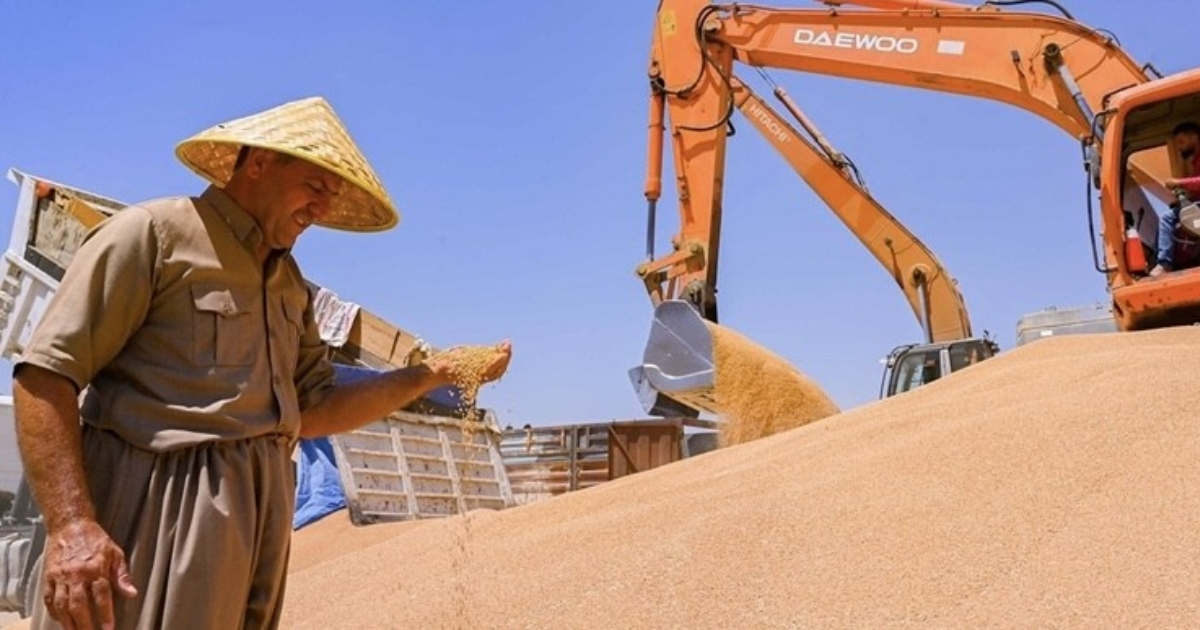
Baghdad’s Wheat Policy is facing growing criticism from the Kurdistan Region, where officials say reduced federal wheat procurement quotas are putting farmers at financial risk despite a strong production season.
The Kurdistan Regional Government’s Ministry of Agriculture and Water Resources has formally objected to Baghdad’s wheat collection plan for the 2025–2026 season. In a letter sent to Iraqi Prime Minister Mohammed Shia al-Sudani, the ministry said the latest quota for the Kurdistan Region is unfair and does not reflect real production levels.
Under the current federal proposal, Baghdad plans to collect 3.8 million tons of wheat from central and southern Iraq while assigning only 292,000 tons to the Kurdistan Region. Kurdish officials rejected that figure and said the gap shows unequal treatment toward farmers in the Region.
Baghdad’s Wheat Policy Sparks Objections From Erbil
Officials in Erbil say Baghdad’s Wheat Policy ignores both local production capacity and basic agricultural standards. The Kurdistan Region has asked the federal government to purchase at least 50 percent of this year’s expected wheat harvest, which officials estimate could reach 2.5 million tons.
Agriculture ministry spokesperson Hewa Ali said the Region has already conveyed its objections to Baghdad. He warned that if the federal government does not buy enough wheat from local farmers, many may be forced to sell to private traders at lower prices.
Officials say those traders could then move the wheat to central and southern provinces and resell it to government silos for higher rates. That would leave Kurdistan Region farmers carrying the loss while others profit from the difference.
In return for a larger federal purchase, the Kurdistan Region has said it would work to block imports of foreign wheat and tighten controls on wheat movement between provinces during harvest season.
Rising Production Meets Lower Procurement
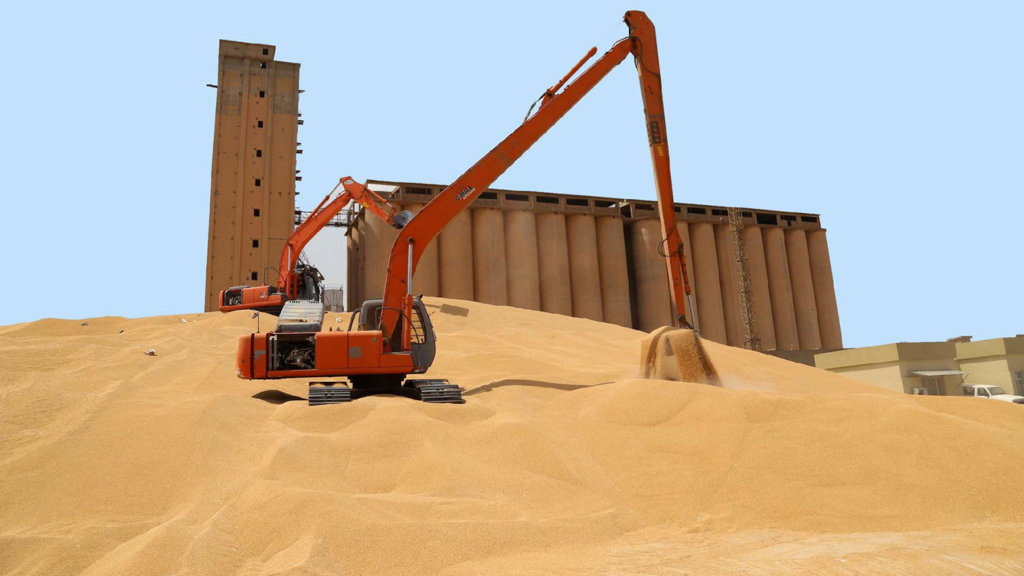
The dispute comes as wheat production in the Kurdistan Region is expected to increase. Around 3.3 million dunams of land have been planted with wheat this year, and strong rainfall has improved conditions across many farming areas.
Officials say rainfall levels between 600 and 1,000 millimeters could help push total output above 2.5 million tons. Even with that outlook, Baghdad’s current quota remains far below local expectations.
The difference is also clear in the per-dunam allocation. Farmers in central and southern Iraq can reportedly sell between 750 and 900 kilograms per dunam under the federal plan. In the Kurdistan Region, the quota stands at only 88.5 kilograms per dunam.
Regional officials say that gap cannot be justified by production data and does not match the scale of cultivation in the Region.
Federal Wheat Purchases Continue to Decline
The latest figures show a continued drop in federal wheat purchases from the Kurdistan Region over the past two years.
In 2024, Baghdad purchased about 700,000 tons of wheat from Kurdistan Region farmers. In 2025, that amount fell to 400,000 tons. This season, the figure has dropped again to 292,000 tons.
Officials in the Region say this pattern is creating serious pressure on farmers who depend on government procurement prices to cover production costs and protect their income.
They argue that Baghdad’s Wheat Policy is not keeping pace with agricultural growth in the Region and leaves farmers exposed to unstable private markets.
Makhmour Highlights Pressure on Farmers
In Makhmour, local agricultural data shows the pressure farmers are facing on the ground. Authorities say around 700 Kurdish and Arab farmers have been registered in the district, along with another 160 who rely only on rain-fed wheat farming.
Marwan Hussein, head of Erbil’s agricultural directorate, said this year all farmers with irrigation systems in Makhmour will have 100 percent of their wheat purchased through the local silo plan. That covers about 40,000 dunams.
He also said another 27,000 dunams have been planted with rain-fed wheat this season, helped by strong rainfall that lowered irrigation needs.
Even so, recent experience shows the limits of current procurement systems. In 2024, the Kurdistan Region produced around 700,000 tons of wheat, but only 400,000 tons were purchased through government silos at supported prices. The rest was sold through local companies and informal markets.
That gap remains a key concern for officials, who say higher production means little if farmers cannot access fair government purchasing channels.
Farmers Seek Equal Treatment
Kurdistan Region officials say farmers should be given the same delivery and marketing rights as those in the rest of Iraq. They also point to the Region’s role in food production and its storage capacity of more than one million tons.
With harvest season approaching, the dispute over Baghdad’s Wheat Policy has become more than a budget issue. For many farmers, it now touches directly on income, crop security, and whether their wheat will be sold at fair value.
Erbil says the current quota does not match reality in the fields. Unless the federal government revises its approach, officials warn that farmers across the Kurdistan Region may face another season of avoidable losses.