
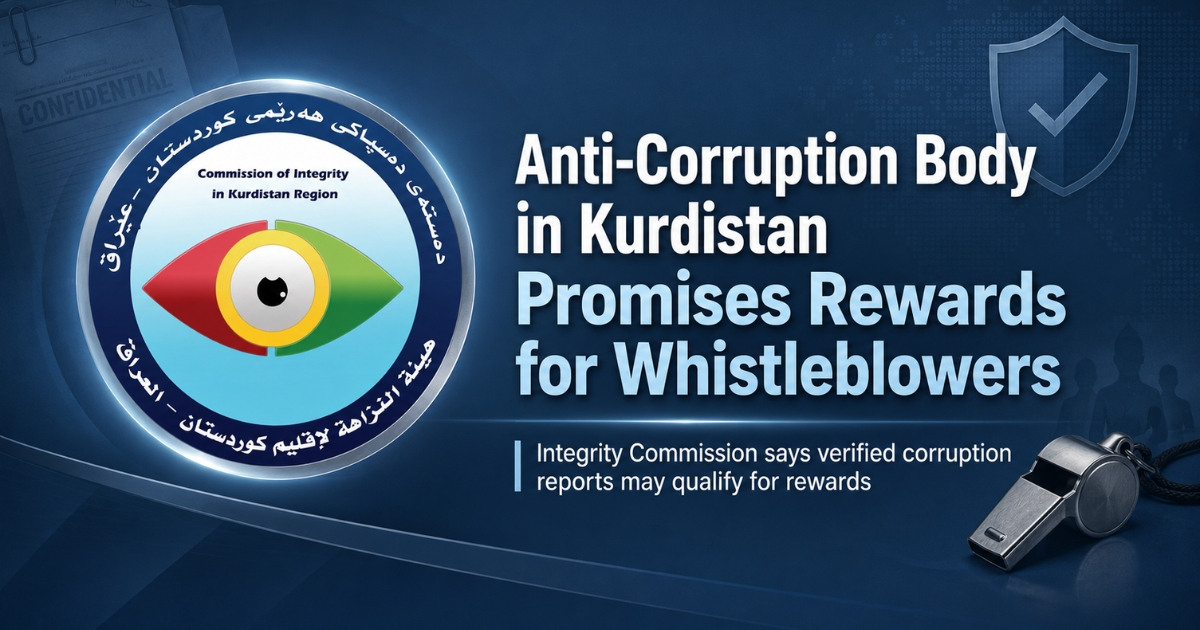
The Kurdistan Whistleblower Rewards program marks a new step in the Region’s fight against corruption. The Kurdistan Region’s Integrity Commission says citizens and public employees can receive financial rewards if they report verified corruption cases inside government institutions.
The move is simple on paper. A person reports corruption. The Commission reviews the evidence. If the case is confirmed, the whistleblower may receive a reward. Their identity is meant to stay protected.
But the real test will not be the announcement. It will be whether people feel safe enough to come forward.
Kurdistan Whistleblower Rewards Depend on Proof and Protection
The Integrity Commission said reports must be supported by evidence. This matters. A reward system without proof can become a tool for false claims, political pressure, or personal disputes.
The Commission also said informants’ names and addresses will be protected. That promise is central to the policy. In a small society, where family ties, party links, and workplace pressure matter, fear can stop people from speaking.
The Commission has also pointed to several ways to report corruption, including a hotline, email, and in-person complaints. The hotline number is 1015.
Officials say the reward amount has not been fixed yet. A committee is expected to decide payments based on the size and seriousness of each case.
That is reasonable, but the public needs clear rules. People should know what counts as strong evidence. They should know how rewards are calculated. They should know how long cases may take. They should also know what happens if a powerful official is named.
Without those answers, the program may bring tips, but not trust.
Why the Timing Matters
The Kurdistan Region has faced years of public concern over bribery, misuse of funds, weak oversight, and political influence inside state institutions.
A 2025 UNDP report on grand corruption trends in the Kurdistan Region reviewed 149 cases. It noted that Erbil’s Fourth Criminal Court has been set up as a dedicated venue for corruption cases. Nearly half of the reviewed cases resulted in convictions, while 77 cases remained ongoing.
That shows two things at once. The system is moving. But it is also slow.
The new reward program could help investigators find stronger leads. It could also help uncover cases that never reach court because insiders stay silent.
Corruption is hard to prove from the outside. The most useful evidence often comes from people inside offices, ministries, banks, contracts, customs systems, and procurement departments.
That is why whistleblowers matter.
Outside Examples Show What Works
Other countries have used whistleblower rewards with mixed but useful results.
In the United States, the Securities and Exchange Commission has a major whistleblower program. Eligible people who provide original information can receive 10% to 30% of money collected if enforcement action leads to more than $1 million in sanctions.
That model works because the reward formula is clear. People know the possible range. They also know the program is tied to real recoveries.
The U.S. False Claims Act is another example. It allows private people to help expose fraud against the government. In fiscal year 2025, False Claims Act settlements and judgments passed $6.8 billion. That shows how powerful inside information can be when the law gives whistleblowers a role.
The European Union has taken a different path. Its whistleblower rules focus on protection. The EU requires safe reporting channels and protection from retaliation for people who report breaches of EU law.
Kurdistan can learn from both models.
The U.S. example shows that rewards can bring strong evidence. The EU example shows that money is not enough. People also need legal safety, workplace protection, and real confidentiality.
Kurdish Weekly View
In our view, Kurdistan Whistleblower Rewards can be a useful reform, but only if the program is handled with care.
Rewards may encourage people to speak. But fear is stronger than money if people believe they could lose their job, face pressure, or be exposed.
The Commission should publish clear guidelines. It should explain how evidence will be reviewed. It should state who decides the reward. It should give a timeline for cases. It should also publish general results without naming whistleblowers.
For example, the public should be able to see how many tips were received, how many were dismissed, how many became formal cases, how many reached court, and how much money was recovered.
That kind of reporting would protect identities while building trust.
The reward program should also avoid becoming a political weapon. Anti-corruption work must apply to every ministry, party, office, and official. If people believe enforcement is selective, the program will lose credibility.
Kurdistan does not only need people to report corruption. It needs institutions that can act on those reports without fear or favor.
What Should Happen Next
The Integrity Commission should move quickly on four steps.
First, it should publish the reward scale. A percentage-based model may be more trusted than an unclear payment.
Second, it should create a secure digital reporting system. People should be able to upload documents, photos, contracts, and messages in a protected way.
Third, it should add legal protection against retaliation. A whistleblower who reports in good faith should not be punished at work.
Fourth, it should release public updates every few months. These updates should show progress without revealing private details.
This would help the public judge whether the policy is working.
A Serious Reform Needs Serious Follow-Through
Kurdistan Whistleblower Rewards could become one of the Region’s most practical anti-corruption tools. It gives ordinary people and public workers a direct role in protecting public money.
But the policy must prove itself through action.
A reward is only one part of the system. The harder work is protection, investigation, prosecution, and recovery of stolen funds.
If the Commission protects whistleblowers, follows evidence, and reports results, this program could build public trust. If it becomes vague or selective, it may become another announcement that fades.
For now, the idea is worth watching closely. It gives Kurdistan a chance to show that fighting corruption is not only a slogan, but a process with real consequences.