
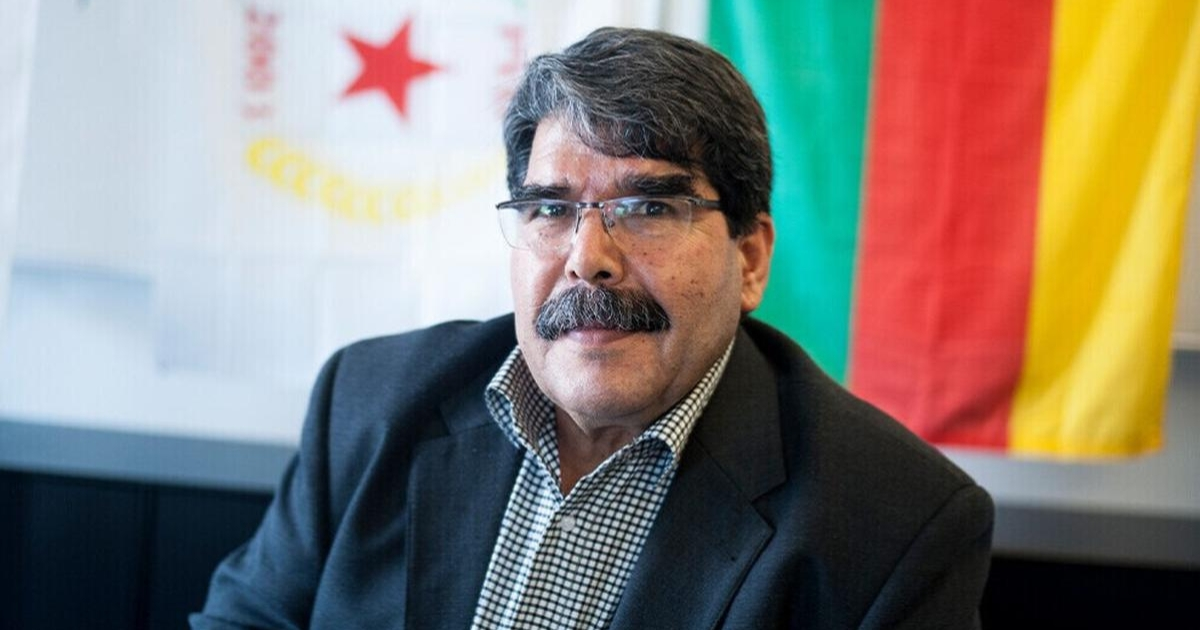
ERBIL — Salih Muslim, a prominent Kurdish political figure from Rojava and a former co-chair of the Democratic Union Party (PYD), died Wednesday evening in Erbil after suffering kidney failure. The news was confirmed by a PYD representative.
Muslim, 74, had been receiving treatment at a hospital in Erbil for about a week under intensive medical supervision before his death on March 11. According to PYD representative Abu Mazloum, his body will remain overnight at the forensic medical department in Erbil before being transferred to Rojava on Thursday. He is expected to be buried in Kobani.
Born in 1951 near Kobani, Muslim completed his early education in the area before continuing his studies in Syria. He attended schools in Damascus and Aleppo, including Al-Kawakibi secondary school. He later pursued higher education abroad, graduating with a degree in chemical engineering from Istanbul Technical University in 1977. After completing his degree, he traveled to London to study English.
Muslim became involved in Kurdish political activism early in his life and spent decades engaged in political work focused on Kurdish rights in Syria. In 2003, he was among the founding members of the Democratic Union Party (PYD), a political movement that later became one of the most influential Kurdish parties in northern Syria. Over the years, he emerged as one of the party’s most internationally recognized representatives.
Related: KRG Rejects Claims of Role in Arming Kurdish Iranian Opposition Groups
During the Syrian conflict, Muslim played a visible role in advocating for Kurdish self-administration in northern Syria, often representing the PYD in regional and international discussions about the future of the country and the status of Kurdish communities.
Leaders across the Kurdistan Region expressed condolences following the news of his passing.
Kurdistan Region President Nechirvan Barzani said Muslim “spent his life in political work to achieve the legitimate rights of the Kurdish people” and described him as “a prominent Kurdish leader in Syria who played a significant role in various stages of the struggle.” Barzani also offered prayers for mercy and compassion for Muslim’s soul.
The Political Bureau of the Patriotic Union of Kurdistan (PUK) also issued a statement mourning his death. The group described Muslim as a key figure in the struggle for Kurdish rights and in efforts to establish self-administration in Rojava. The statement said his death represents a significant loss for the Kurdish people and for the broader political movement in Western Kurdistan.
Muslim’s personal life was also shaped by the conflict in Syria. He was the father of five children. His son, Sherwan, was killed in 2013 during fighting in Ras al-Ayn in northern Syria. In its condolence statement, the PUK referred to Sherwan as a martyr who gave his life for the freedom of the homeland.
Salih Muslim’s decades-long political career placed him among the most recognized Kurdish political figures connected to the Rojava administration. His death marks the passing of a figure closely tied to the modern Kurdish political movement in northern Syria.