
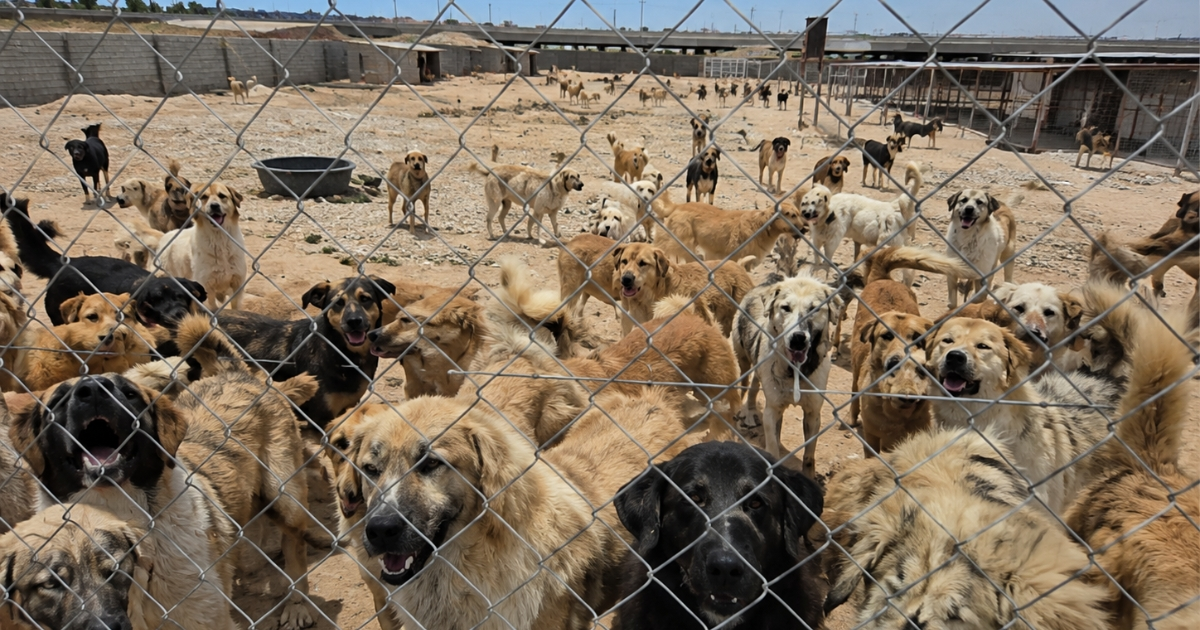
The crisis facing Kirkuk Stray Dogs is no longer only an animal welfare issue. It is now a public health, budget, and governance test for local authorities.
Kirkuk moved away from killing stray dogs after public pressure from animal rights groups. That shift was important. It showed that officials understood the public no longer wanted mass killing as the main answer to a growing urban problem.
But the replacement system is now under strain.
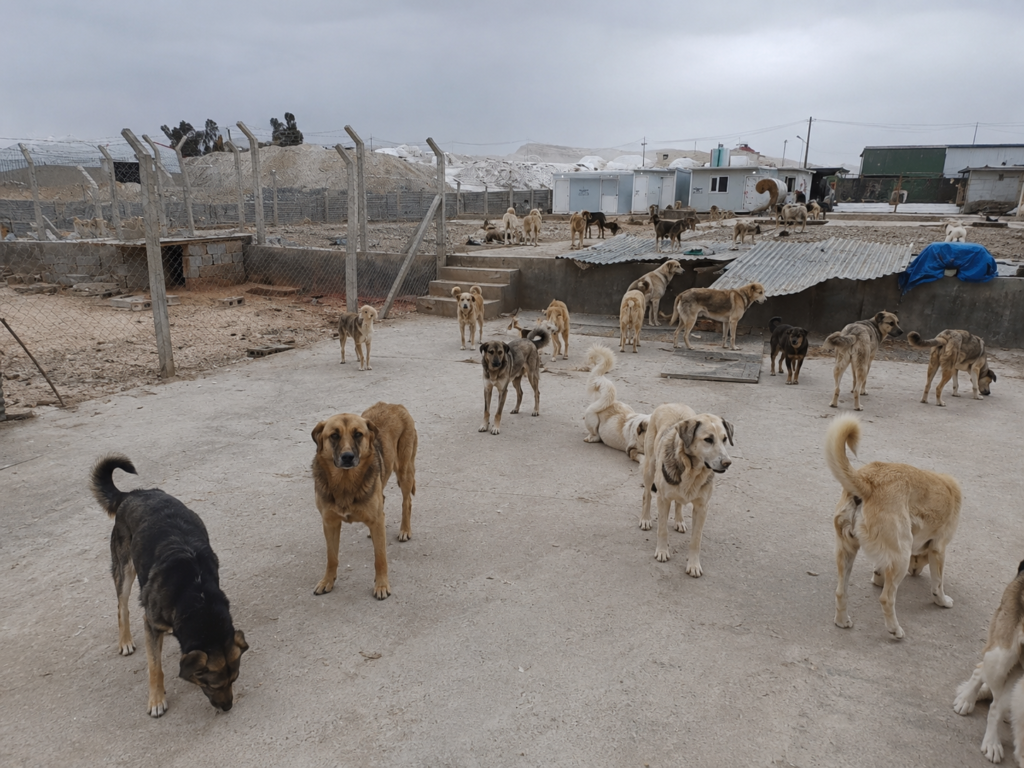
A shelter opened outside Kirkuk in 2023 was meant to protect residents and animals at the same time. Instead, volunteers say hundreds of dogs are now living with limited food, water, medicine, and shelter. Around 700 dogs and 150 puppies are reported to be inside the facility.
The question is now clear: Did Kirkuk stop one harmful policy without building a working alternative?
Kirkuk Stray Dogs Raise Questions About Public Responsibility
The shelter was created on five acres of land outside Kirkuk after several stray dog attacks caused public concern. Some attacks involved children. The local government needed a response that could protect people while avoiding the public backlash that came with killing dogs.
The shelter looked like a compromise.
But a shelter cannot work without a budget. It cannot depend on leftover food, volunteer labour, and irregular water deliveries. It also cannot handle rising dog numbers without sterilization, vaccination, and clear intake rules.
This is where Kirkuk’s approach appears to have failed.
Officials ended the killing of stray dogs, but they did not appear to build a full dog population management plan. The result is a shelter that may now be causing the same suffering it was meant to prevent.
Current Breakdown of the Kirkuk Shelter Crisis
| Issue | Current Situation | Main Concern |
|---|---|---|
| Dogs inside the shelter | Around 700 | Overcrowding and disease risk |
| Puppies inside the shelter | Around 150 | High risk from heat, cold, and lack of care |
| Daily water need | About two tankers | Supply is not steady |
| Food source | Donations, restaurant leftovers, poultry waste | Not reliable or balanced |
| Government role | Limited support in recent months | No stable operating budget |
| Medical care | Limited | Disease can spread faster |
| Sterilization system | Not clearly in place | Continuous breeding |
| Shelter transport | Vehicle reportedly reclaimed | Food collection harder |
This table shows the core problem. The shelter is not only underfunded. It is also unmanaged as a long-term system.
A humane shelter needs records, food supply, veterinary care, clean water, population control, and trained staff. Without these basics, the shelter becomes a holding site.
What Went Wrong?
Kirkuk appears to have treated the shelter as the solution itself.
But a shelter is only one part of a solution.
A full plan would likely include four steps:
| Step | Purpose | Why It Matters |
| Vaccination | Reduce disease risk | Protects humans and animals |
| Sterilization | Slow population growth | Prevents overcrowding |
| Registration and tracking | Control intake and movement | Helps manage numbers |
| Public education | Reduce abandonment and fear | Builds community support |
Without these steps, the shelter keeps receiving dogs but has no path to reduce the pressure.
This creates a cycle.
More dogs enter. More puppies are born. Food costs rise. Water demand rises. Disease risk grows. Volunteers become overwhelmed. Officials then return to the idea of euthanasia because the shelter becomes too hard to manage.
That is not a real policy. It is a delayed crisis.
Outside Comparison: What Other Models Show
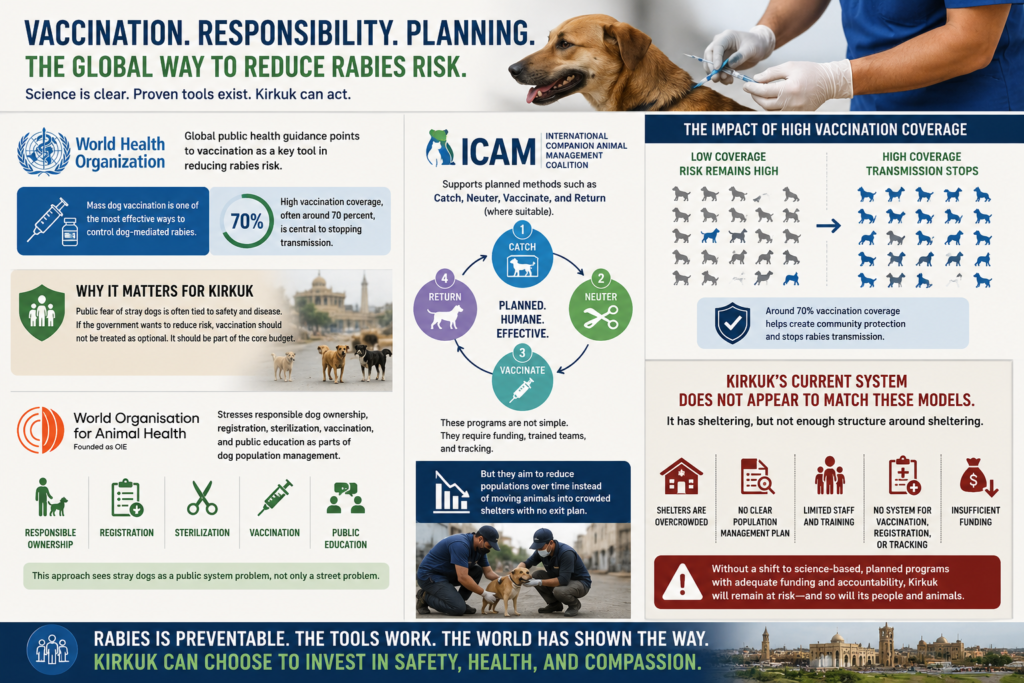
Global public health guidance points to vaccination as a key tool in reducing rabies risk. The World Health Organization has said mass dog vaccination is one of the most effective ways to control dog-mediated rabies. It also notes that high vaccination coverage, often around 70 percent, is central to stopping transmission.
This matters for Kirkuk because public fear of stray dogs is often tied to safety and disease. If the government wants to reduce risk, vaccination should not be treated as optional. It should be part of the core budget.
The World Organisation for Animal Health also stresses responsible dog ownership, registration, sterilization, vaccination, and public education as parts of dog population management. This approach sees stray dogs as a public system problem, not only a street problem.
The International Companion Animal Management Coalition has also supported planned methods such as catch, neuter, vaccinate, and return where suitable. These programs are not simple. They require funding, trained teams, and tracking. But they aim to reduce populations over time instead of moving animals into crowded shelters with no exit plan.
Kirkuk’s current system does not appear to match these models.
It has sheltering, but not enough structure around sheltering.
Chart: Three Policy Options Facing Kirkuk
| Policy Option | Short-Term Effect | Long-Term Risk | Humane Value |
| Return to killing stray dogs | May reduce visible street numbers for a time | Public backlash, repeated cycles, no root solution | Low |
| Keep shelter without funding | Removes some dogs from streets | Hunger, disease, overcrowding, more deaths | Low to medium |
| Build a funded vaccination and sterilization plan | Slower results at first | Needs budget and trained staff | High |
This comparison shows why Kirkuk is stuck.
The fastest option may not be the most effective. The cheapest option may become costly later. The most humane option needs planning, not slogans.
The Public Safety Question
Residents have real concerns.
Stray dog attacks can frighten families. Parents worry about children walking to school. Shop owners worry about packs near markets. Health workers worry about rabies and other diseases.
These concerns should not be dismissed.
But public safety cannot depend on a shelter that lacks food and water. It also cannot depend on short-term killing campaigns that do not stop the next generation of stray dogs from appearing.
A serious public safety plan must ask:
Why are so many dogs on the streets?
How many are abandoned owned dogs?
How many are breeding freely?
How many are vaccinated?
How many areas report the most attacks?
How many bites are recorded each month?
Without answers, officials are reacting instead of governing.
The Animal Welfare Question
The shelter was created to prevent cruelty. That goal still matters.
But if dogs are placed in a facility where they face hunger, disease, extreme weather, and overcrowding, the public has a right to ask whether the policy is still humane.
A shelter should reduce suffering. It should not hide it.
This is why volunteers are warning that the situation cannot continue. Donations may keep the shelter alive for a short time, but charity cannot replace government responsibility.
If Kirkuk wants to keep the shelter open, it needs a basic operating plan.
That plan should include:
| Need | Practical Action |
| Food | Monthly supply contracts, not random leftovers |
| Water | Guaranteed daily tanker schedule |
| Medicine | Veterinary budget and disease control |
| Sterilization | Male and female separation, then surgery program |
| Data | Public monthly reports on dog numbers and deaths |
| Adoption | Local adoption and foster campaigns |
| Oversight | Joint committee with officials, vets, and volunteers |
These steps would not solve the crisis overnight. But they would move Kirkuk from emergency response to actual management.
Why Donations Alone Cannot Solve This
Volunteers are doing the work that a public system should support.
They collect food. They monitor the dogs. They speak to donors. They respond to emergencies. They also carry the emotional weight of watching animals decline when supplies run out.
This is not sustainable.
A city cannot outsource animal control to unpaid people and then blame the shelter when conditions collapse.
If the shelter is a government project, it needs government funding. If it is not a government project, then officials must be honest about who is responsible.
Right now, the answer appears unclear.
That lack of clarity is part of the crisis.
A Better Plan for Kirkuk Stray Dogs
Kirkuk needs a model that protects people and animals at the same time.
A stronger plan could include five phases.
| Phase | Action | Expected Impact |
| Phase 1 | Emergency food, water, and medicine budget | Stops immediate decline |
| Phase 2 | Full dog count and health screening | Shows the real scale |
| Phase 3 | Vaccination drive | Reduces disease risk |
| Phase 4 | Sterilization and separation | Slows population growth |
| Phase 5 | Adoption, education, and enforcement | Reduces abandonment |
This plan would require money. But the current crisis also costs money. It costs volunteer time, public trust, health risk, and political pressure.
The real question is not whether Kirkuk can afford a humane plan.
The question is whether Kirkuk can afford to keep avoiding one.
What This Means for the Wider Region
The Kirkuk case should matter beyond Kirkuk.
Cities across Iraq and the Kurdistan Region face similar issues with stray animals. Fast urban growth, weak municipal systems, poor waste control, and low sterilization rates all add to the problem.
If Kirkuk’s shelter fails, it may discourage other cities from trying shelter-based reform. It may also give support to those who argue that killing is the only practical answer.
That would be a step backward.
The better lesson is different: humane policy must be funded, measured, and managed.
A shelter without a budget is not reform. It is a pause before the next crisis.
Kurdish Weekly Analysis
The case of Kirkuk Stray Dogs shows how policy can fail after a good first step.
Stopping mass killing was a major change. But it was not enough.
Kirkuk now needs a funded plan built around public safety, vaccination, sterilization, veterinary care, and humane shelter management. The current approach leaves too much pressure on volunteers and too little accountability on government.
The shelter should not become a place where suffering is moved out of public view.
If local authorities want public trust, they must show a clear plan. That means publishing numbers, assigning a budget, working with veterinarians, and building a system that reduces stray dog populations over time.
Until then, Kirkuk’s shelter will remain a warning.
Good intentions do not save lives without structure.
Why Did Kirkuk Stop Killing Stray Dogs?
Kirkuk stopped the practice after pressure from animal rights advocates and public concern over mass killing. The city shifted toward sheltering dogs instead.
Why Are the Dogs Still Dying?
Volunteers say the shelter lacks steady food, water, medicine, transport, and proper facilities. Overcrowding and disease have made the situation worse.
How Many Dogs Are in the Shelter?
Reports say around 700 dogs and 150 puppies are currently inside the shelter.
Is the Shelter Government-Run?
The shelter was created as a government-backed project, but volunteers say local authorities have reduced direct support in recent months.
Why Is Sterilization Important?
Sterilization helps reduce the number of puppies born inside shelters and on the streets. Without it, overcrowding continues.
What Is the Public Health Concern?
Stray dogs can carry diseases, including rabies. Vaccination programs help reduce this risk and protect both people and animals.
Is Releasing the Dogs Back to the Streets a Solution?
It may reduce suffering inside the shelter, but it does not solve the wider public safety issue. A real plan must include vaccination, sterilization, tracking, and public education.
What Should Kirkuk Do Next?
Kirkuk should provide emergency funding, secure daily food and water, start vaccination and sterilization programs, separate male and female dogs, and publish monthly shelter data.
Can Donations Solve the Problem?
Donations can help in the short term, but they cannot replace a stable public budget. The shelter needs government support to operate safely.
What Is the Main Lesson From This Crisis?
Ending mass killing was only the first step. Kirkuk now needs a complete animal management policy that protects residents while treating animals humanely.