


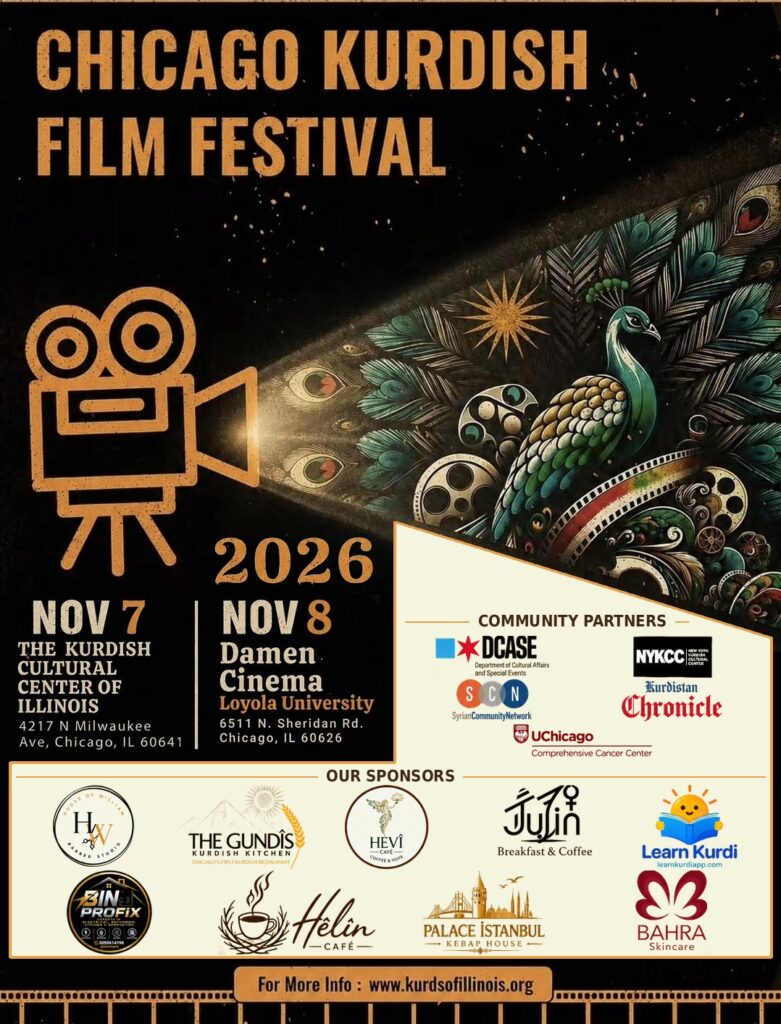
Kurdish Cinema heads to Chicago on November 7 and 8 for the third Chicago Kurdish Film Festival. Films in Sorani and Kurmanji will bring Kurdish stories to audiences across the city and the US Midwest.
The Kurdish Cultural Center of Illinois runs the event. Screenings will take place at the center on Saturday and at Loyola University Chicago’s Damen Cinema on Sunday.
Kurdish Cinema Connects Audiences With Their Roots
Festival co-organizer Dalal Hassane told Rudaw that the event gives members of the Kurdish diaspora a way to connect with their heritage. She said film can also show parts of Kurdish life that wider discussions often miss.
The program brings together films and documentaries. Their stories explore Kurdish history, social divisions and the effects of violence through the people who live with them.
Hassane urged community members to attend and support the filmmakers. For Kurdish audiences raised abroad, the festival offers a shared space to hear their languages and see stories linked to their roots.
Kurdish Cinema Screenings Across 2 Venues
Saturday’s program starts at 3 p.m. at the Kurdish Cultural Center of Illinois, 4217 N Milwaukee Avenue. A bazaar and reception will precede a panel on art and literature.
Short films that evening include Tea for Three, Rojin’s Dream and The Land of Buried Women.
Sunday’s screenings run from noon to 9 p.m. at Damen Cinema, 6511 N Sheridan Road. The lineup includes Who Am I?, File No. 1, Night and Fog in Kurdistan and Footprints of Ants.
Kurdish Cinema Reaches US Festival Audiences
The Chicago event follows the tenth New York Kurdish Film Festival. That festival showed 30 films across six days, with work from Kurdistan and the diaspora.
Kurdish Cinema Has a Wider Festival History
Chicago’s event forms part of a wider network of Kurdish film festivals. These events give audiences a place to find work that they may not see in their local cinemas. They also bring films from different places into one program.
The London Kurdish Film Festival says it has shown Kurdish Cinema since 2001. Volunteers support its work. Its program includes screenings, talks and other events that connect filmmakers with the public.
The London festival describes a role that reaches beyond showing films. It seeks to bring Middle Eastern and Western audiences together. For viewers new to Kurdish stories, that shared space can provide a starting point for further reading and viewing.
From Short Films to International Screens
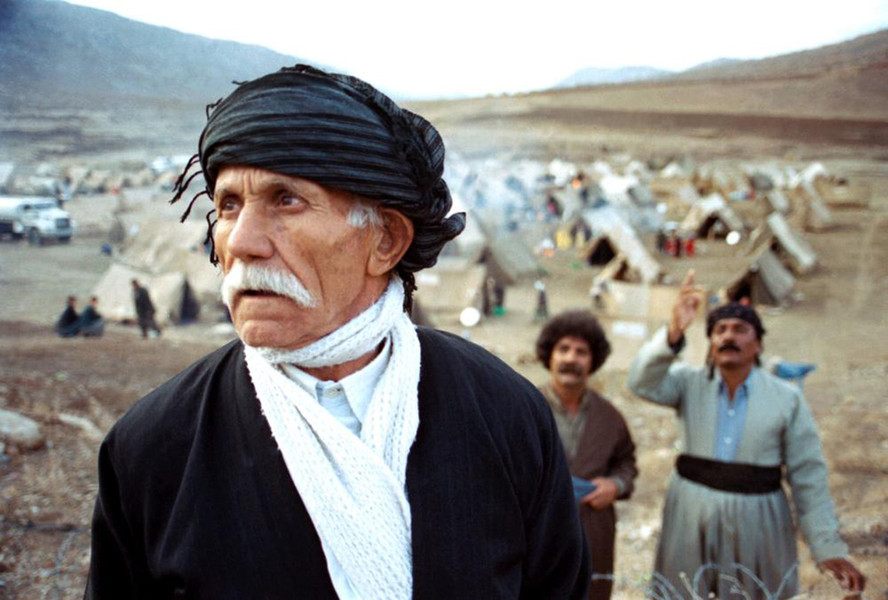
Kurdish Cinema also has a history in major museums. In 2008, New York’s Museum of Modern Art held a film series devoted to Bahman Ghobadi. The program ran from June 27 to July 7 as part of its work with the Robert Flaherty Film Seminar.
MoMA’s account of Ghobadi’s work traces his path through short films and documentaries. He learned his craft while filming Kurdish communities on 8mm film. His early work drew on the lives of people near the border between Iran and Iraq.
His short film Life in Fog followed a boy who cared for his siblings after their parents died. That story helped form the basis for his feature A Time for Drunken Horses. The link shows how a story first told in a short film can grow into a longer work.
These earlier films provide background to Kurdish Cinema. They are separate from the Chicago lineup listed for this weekend.
Kurdish Cinema Beyond This Weekend: Films That Reached World Festivals
The Chicago screenings sit within a longer history of Kurdish Cinema reaching audiences abroad. The following films offer context for that history. They are not listed as part of the 2026 Chicago program. Each example shows a different route by which a film can reach viewers beyond the place where its story began.
Festival records also help readers separate an award from a screening. A place in a main competition does not mean a film won the top prize. A later museum season is different from a first release. Keeping those details clear gives a more useful picture of how films travel.
A Cannes Milestone: Yol
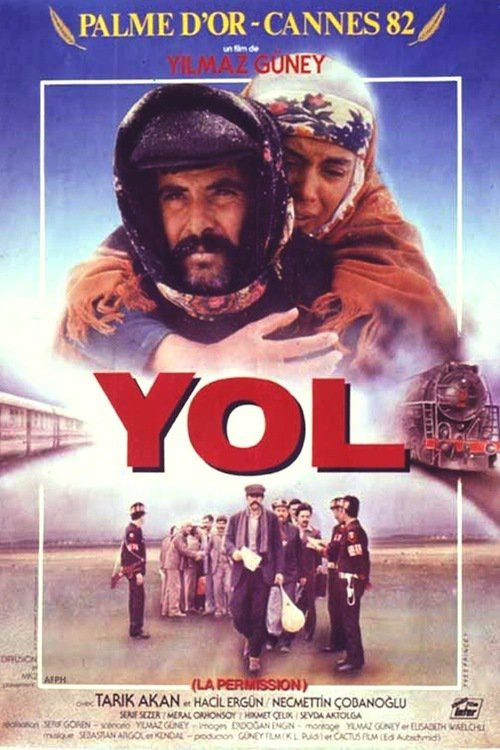
The Cannes archive lists Yol as a joint winner of the Palme d’Or in 1982. It credits Şerif Gören and Yılmaz Güney as directors, with Güney also named as screenwriter. The record places the film in the main feature competition that year.
That shared credit is worth keeping in view when discussing Kurdish Cinema. Films emerge from the work of many people. A short account that names only one person can leave out part of their production history. The archive gives readers a direct source for the film’s credits and award.
In 2017, Cannes returned to Yol through its Classics program. A festival account of the restored version described the role of producer Donat F. Keusch. It also recalled how Güney sent detailed instructions to Gören from prison while the film was being made.
The restored version added a sixth story missing from the earlier edit. The team also worked on the sound. Cannes said the restoration drew on the original negative and other film materials. This was a return to an older work, with changes that let audiences encounter another version of it.
For viewers exploring Kurdish Cinema, restoration raises a useful question: which version of a film are they watching? A title and year may not tell the whole story. An archive note can explain a new cut, restored sound or added scenes. Those details matter when comparing reviews written at different times.
A Time for Drunken Horses and the First Feature Award
A Time for Drunken Horses brought Bahman Ghobadi a major award in 2000. The AFI FEST archive records its Caméra d’Or win at Cannes. That prize recognizes a first feature, a different distinction from the Palme d’Or.
AFI’s entry names Ghobadi as both director and producer. It credits Saed Nikzat for the photography and Samad Tavazoui for editing. The cast includes Ayoub Ahmadi, Roujin Younesi and members of the Ekhtiar-Dini family. The archive lists the film in its 2000 Asian New Classics section.
The film centers on children facing hard work and harsh conditions. AFI’s description draws attention to child labor and the way the film presents its young characters. The record offers a route into both the story and the craft behind it, from the performances to the images.
Its festival path helps explain why Kurdish Cinema history includes both local stories and international institutions. A film can begin with a small group of characters in one place. Its later life may include screenings and discussion in many countries. The scale of the release does not change the scale of the human story.
Turtles Can Fly and San Sebastian
Another Ghobadi film, Turtles Can Fly, won the Golden Shell for best film at San Sebastian in 2004. The festival’s 2016 retrospective entry records that award and the film’s return to a later program.
The story takes place in Iraqi Kurdistan as people seek news of the coming US attack on Iraq. The festival’s synopsis describes villagers trying to find a satellite dish. Their search links the need for news to the uncertainty of daily life before war.
The archive lists Ghobadi as director and screenwriter. It names Shahriar Assadi as cinematographer and Hossein Alizadeh as composer. It gives a running time of 95 minutes and lists Iran and Iraq as the production countries.
For a viewer tracing Kurdish Cinema, this entry shows the value of looking beyond a release year. The film appears in a record from 2016, but it dates from 2004. The later date refers to a retrospective screening. It does not mark a new production or a new award.
Hiner Saleem’s Kilometre Zero
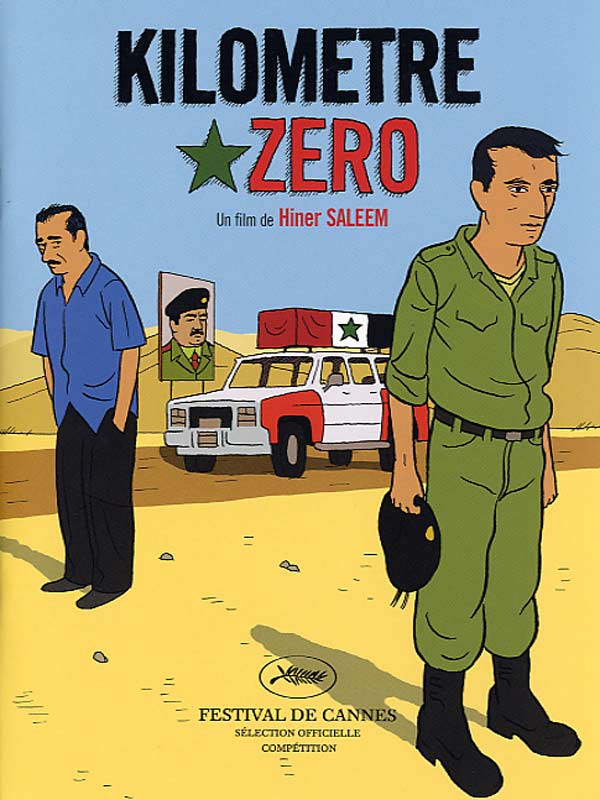
Ghobadi is one part of this wider field. Hiner Saleem’s Kilometre Zero appeared in the main competition at Cannes in 2005. The official Cannes entry credits Saleem as director and screenwriter and lists a running time of 91 minutes.
The story is set in Iraq in 1988. Ako, a Kurdish husband and father, must serve in Saddam Hussein’s army. He wants to leave the country, while his wife wishes to stay with her ill father. His duties later send him on a journey with a soldier’s body.
The film uses that journey to place family ties, prejudice and war within the same story. Cannes lists Nazmi Kırık as Ako and Belçim Bilgin as Salma. The archive confirms its competition selection. It does not list a Palme d’Or win for the film.
This is another useful distinction for Kurdish Cinema coverage. Selection itself puts a work before a festival audience, but an article should name the recognition it received. Clear credits let readers follow a director, actor or writer into other work without turning every appearance into an award claim.
Music and Travel in Half Moon
Kurdish Cinema also brings music into stories about movement and borders. In a 2007 tribute to Ghobadi, Tribeca discussed Half Moon. It described an older musician’s effort to stage a concert in Iraq that would include women singers.
Tribeca said the film formed part of a group of works commissioned by Vienna to mark 250 years since Mozart’s birth. It drew inspiration from Mozart’s Requiem. The film screened at Tribeca in 2007 and began a New York theatrical run that December.
That production history connects a Kurdish story to a wider arts project. It also gives viewers another way to approach the film: through music, performance and the effort to bring people together for a concert. The subject reaches beyond a simple account of a border crossing.
These examples do not define all Kurdish Cinema. They provide a small set of documented starting points. A viewer who begins with one director can follow the credits, read an archive entry and then seek work by others. No single film can stand in for the lives or views of a whole people.
A Viewer’s Guide to Kurdish Cinema
A festival program can feel dense to someone seeing these films for the first time. A few basic distinctions help. A short film describes length, not subject. A documentary describes an approach to real people and events. A feature describes a longer work. Those terms can overlap.
A short documentary and a short drama may appear in the same session. Both may deal with similar themes while using different methods. A documentary can draw on interviews, records and scenes from daily life. A drama can use scripted scenes and actors. Viewers should check the program description before treating a screen story as a factual record.
In Kurdish Cinema, as in any film tradition, the details of one work matter. The director’s background, the language used and the place where filming took place may tell different parts of its story. A production country in an archive is a credit. It does not, by itself, explain the identity of every person on screen.
Viewers can keep a short list of the films they see, with the director and release year. That makes it easier to find a review or a later screening. It also helps when films share an English title or appear under more than one spelling in different programs.
Questions to Carry Into a Screening
One useful starting point is to ask whose view shapes the story. Does the camera stay with a child, a parent or a group? Does a narrator explain events, or do people speak for themselves? Those choices affect what the viewer knows and what remains outside the frame.
Sound offers another way to look at Kurdish Cinema. Listen for the place of speech, songs, street noise and silence. A scene may use music to guide a response, or leave room for a voice without it. There is no single correct method. The question is how the choices serve the story.
Viewers can also note what a film leaves unresolved. An open ending may invite discussion, but it does not prove what happens next. Keeping an observation separate from an inference makes a conversation about a film more precise. It also helps avoid turning one character’s experience into a claim about all Kurdish people.
For those who discuss Kurdish Cinema with friends or family, start with a scene rather than a broad label. Ask what happened, how the scene was filmed and why it stayed with you. Different viewers may notice different things. Those differences can make a shared screening useful even when people do not agree.
After the Credits
The end credits offer a practical next step. They identify the people who wrote, shot, edited and scored the film. Following one of those names can lead to other work. A festival visit can then become the start of a viewing list rather than a single evening’s experience.
Readers who want to explore Kurdish Cinema at home should check the filmmaker’s, distributor’s or festival’s official pages for viewing options. A past festival listing does not guarantee that a film is now available online. Availability can differ by country and can change over time.
When sharing a recommendation, include the full title, director and year. Avoid posting major plot details without a warning. Link to an official trailer or film page where possible. This gives others enough information to find the work while leaving room for their own first response.
Chicago’s weekend program offers a current entry point into that wider field. The historical examples above show how earlier films reached festivals and museums. The films in this year’s lineup give audiences a chance to begin with the work in front of them, then decide where to look next.
Reading the Records Behind Kurdish Cinema
Archive pages serve a different purpose from reviews. They can establish when a film screened, who received a credit and which award a jury gave it. A review offers an assessment of the film. A director’s interview gives another kind of source: an account of choices, aims and working conditions.
For readers exploring Kurdish Cinema, those sources work best together. A festival entry can confirm a date. An interview may explain why a scene was made in a certain way. A review can draw attention to a performance or an editing choice that a program note does not discuss.
It helps to check the date at the top of each source. A statement about a film’s release from twenty years ago describes that moment. It does not establish where the film can be watched today. The same applies to a past ban, a planned tour or an announced screening.
Names can also appear in different forms across archives. Accents, English spellings and translated titles may vary. When looking for Kurdish Cinema, matching the director and year can help establish whether two pages refer to the same film. A title alone may be too broad to make that match.
Running times sometimes differ between versions. A festival may show a restored print, a new edit or a version prepared for another release. Readers should use the time shown for the screening they plan to attend. An older archive remains useful for history, but it is not a substitute for a current program.
The sources linked here let readers check the basis for the background section. They include records from Cannes, AFI, San Sebastian, Tribeca and MoMA, along with the London festival’s account of its work. Together, they offer several routes into Kurdish Cinema without treating one institution’s selection as a complete history.
Planning a Visit to the Kurdish Cinema Festival
Viewers should check which venue hosts their chosen session before they travel. The Saturday and Sunday programs take place at different addresses. The organizer’s schedule is the best place to check the latest times and ticket details.
Anyone who needs access information, language details or guidance on age suitability should contact the organizer before booking. A film’s title alone does not show its subject matter or whether it suits a young viewer.
The two-day event gives Chicago audiences a chance to see Kurdish Cinema in a shared setting. Its mix of short and longer works offers more than one way into the program. Viewers can use the published schedule to choose the sessions they want to attend.
Readers can check the official Chicago festival program for times and tickets. Further reporting comes from Rudaw’s interview with the organizers.
Find more arts coverage in Kurdish Weekly’s Entertainment section.













Leave a comment