
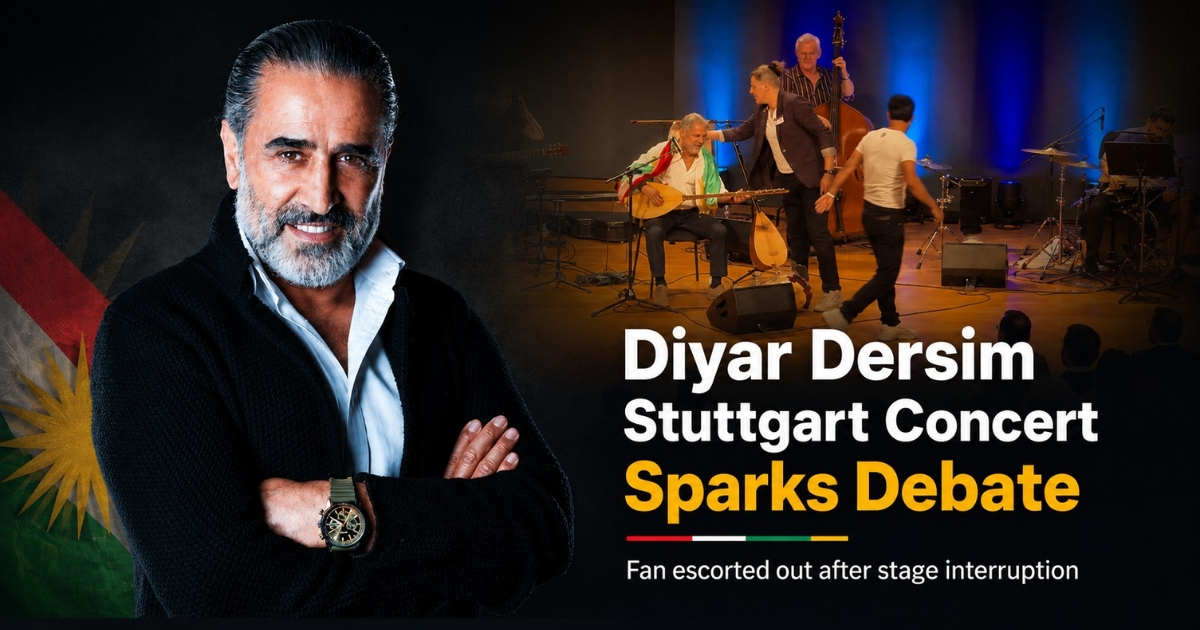
A moment at the Diyar Dersim Stuttgart Concert has sparked debate online after an individual rushed the stage, placed the Kurdistan flag on Kurdish singer Diyar Dersim’s shoulders, and kissed him during the performance.
The concert took place on June 6, 2026, at Mozartsaal at Liederhalle in Stuttgart, Germany.
In the video circulating online, security moved in and escorted the individual out of the venue. The Kurdistan flag was also removed from the situation. Based on the footage reviewed, the man did not appear to be harmed. He was not tackled, struck, or removed with harsh force.
That has not stopped debate. Some viewers have questioned whether the response was political. Others saw it as a basic security measure.
From our observation, the incident appears less like a political matter and more like a venue safety issue.
Diyar Dersim Stuttgart Concert Shows Why Boundaries Matter
The Diyar Dersim Stuttgart Concert was a paid live music event. People attended to hear Diyar Dersim perform. A stage is not an open public space. It is a controlled area where the artist, musicians, crew, and security team work.
When someone rushes that area without permission, the reason matters less than the risk.
The individual may have wanted to show Kurdish pride. The Kurdistan flag carries deep meaning for many Kurds. It represents identity, history, memory, and national feeling. But pride does not give anyone the right to cross stage boundaries.
There is a time and place for every expression.
A concert can be a place for cultural pride. Fans can wave flags from the crowd. They can sing, clap, cheer, and celebrate. But going on stage, touching the performer, kissing him, and placing something on his body crosses a clear line.
That is not only about politics.
It is about consent.
It is about personal space.
It is about safety.
The Security Response Was Expected
Security teams are trained to act fast when someone enters the stage area. They do not have time to guess a person’s full intention. Even if the person appears peaceful, security must treat the breach as a possible risk.
In this case, the response appeared controlled.
The individual was removed. The flag was taken away from the active disruption. The show continued. No serious force was visible in the footage.
That matters.
In many concerts around the world, stage rushers face a much stronger response. Some are tackled. Some are pinned down. Some are arrested. Some cause injuries to performers, security staff, or themselves.
By comparison, the Stuttgart incident appears to have ended in a calm way.
The person who rushed the stage should be thankful the outcome was not worse.
Security Also Appeared to Respect the Flag
One detail should not be ignored.
Security appeared to take the Kurdistan flag out of the person’s hand as part of removing the distraction from the venue. At that point, the flag had become part of the interruption. It was being used during a moment that had already halted the performance and pulled attention away from the artist.
But the way the flag was handled matters.
Based on the footage, security did not appear to crumple it, throw it, or treat it with disrespect. After the person was escorted out, the flag appeared to be folded in a more respectful way.
That detail supports the view that the issue was not the Kurdistan flag itself.
The issue was the stage breach.
The flag had to be removed from the situation because the person was still using it to draw attention while being escorted out. Removing the flag was part of restoring order. Folding it afterward showed that the object itself was not the target of disrespect.
For many Kurds, the flag is sacred in a cultural and national sense. It should be treated with care. But it should also not be used in a way that disrupts an artist, creates tension for security, or interrupts a paid public event.
The situation did not end the moment the individual was walked off the stage.
As security escorted him away, he appeared to climb onto or stand over the railing area and continued to raise the Kurdistan flag. That action again pulled attention away from the performance and toward himself.
Based on the video, he still was not physically harmed. Security did not appear to strike him, tackle him, or use harsh force. He was escorted out in a controlled way, even after continuing to draw attention during his removal.
That detail supports the view that this was handled as a venue security issue, not as an attack on Kurdish identity.
The concern is not Kurdish pride. The concern is the method.
Rushing a stage, touching a performer, interrupting a paid event, and then continuing to raise the flag while being removed does not reflect the best of Kurdish values. Kurdish pride is rooted in dignity, respect, and discipline. It should not be shown in a way that crosses personal boundaries or disrupts an artist’s work.
The Kurdistan flag deserves respect. So does the artist. So does the audience.
One person’s actions should not be used to define Kurds as a whole.
Diyar Dersim Allowed Security to Handle the Situation
Diyar Dersim’s response is also important.
Based on the video, Dersim did not appear to stop security from removing the individual from the stage or venue. He also did not appear to object to the removal of the Kurdistan flag from his shoulders. From the angle shown, he seemed to lean forward as the flag was removed.
He did not pause the performance to acknowledge the incident. He did not appear to speak to the crowd about it. He also did not turn the moment into a public statement.
That does not prove his full view. It does not mean he approved or disapproved of every part of the response. But it does show that, in the moment, he allowed security to handle the situation while the event continued.
Artists are often placed in difficult positions when fans cross the stage. A strong reaction can make the situation worse. Staying calm can help protect the audience, the band, and the flow of the event.
For that reason, Dersim’s decision not to stop the show or acknowledge the disruption supports the view that this was treated as a security matter, not a political confrontation.
Some of the online reaction has focused on the removal of the Kurdistan flag. That is understandable. For Kurds, the flag is not just fabric. It holds emotional weight.
But the key issue is not the flag alone.
The key issue is how it reached the stage.
If a fan hands a flag to an artist with permission, that is one thing. If an artist asks for a flag, that is also different. But when someone runs onto the stage and places it on the artist without clear consent, security has to respond.
The flag was part of the stage breach.
That does not automatically mean the venue acted against Kurdish identity. It may mean the venue removed an object connected to an unauthorized interruption.
The fact that the flag appeared to be folded after the person was removed also matters. It suggests the response was not about disrespecting the flag, but about ending a disruption that had crossed the boundaries of a live performance.
Without an official comment from Diyar Dersim, his team, the venue, or security, it would be unfair to call this a political act.
Stage Rushing Has Led to Worse Outcomes Before
The Stuttgart incident should be viewed in a wider context.
Stage rushing is taken seriously because it has led to dangerous outcomes at other concerts.
At a Rage Against the Machine concert in Ontario in 2022, security chased a fan who rushed the stage. During the response, guitarist Tom Morello was accidentally knocked down. He was able to continue, but the incident showed how even security action can create risk when someone breaches the stage.
At a Beyoncé and Jay-Z concert in Atlanta in 2018, a fan rushed the stage as the performers were leaving. Backup dancers and security stopped him, and police later became involved.
In Prague in 2024, Nick Jonas left the stage during a Jonas Brothers concert after a prohibited laser was pointed at him from the audience. The show was paused before it later resumed.
These cases show why venues do not wait for a situation to become dangerous. They move quickly because a few seconds can change everything.
A Question for the Community
The debate around the Diyar Dersim Stuttgart Concert raises a fair question:
How can Kurds show pride at public events without putting artists, venues, and other fans in a difficult position?
The answer is not to silence cultural pride.
The answer is to express it with respect.
Fans can bring flags where allowed. They can wear Kurdish colors. They can chant, sing, and celebrate from the crowd. They can support Kurdish artists with tickets, streams, shares, and public respect.
But rushing the stage is not support.
It shifts attention away from the artist. It disrupts the show. It puts security in a position where they must act.
That can turn a small moment into a public debate.
This Should Not Become a Major Controversy
At the end of the day, this does not appear to be a serious political incident.
No public statement has been made by Diyar Dersim or his team. The video does not show the man being harmed. The security response looked like a standard venue decision after an unauthorized stage entry.
People can disagree with the optics. They can feel upset about the flag being taken from the person. But the basic facts point toward a security matter. Security also appeared to handle the flag with care after removing it from the disruption.
The stronger lesson is simple.
Respect the artist. Respect the stage. Respect the audience.
Kurdish pride does not need to cross someone’s personal space to be seen.